12 Questions You Should Ask Every CPQ Provider
Author: Elisabeth Sonnleitner
Choosing a CPQ system is a big step. At first glance, many solutions look similar. But in practice, major differences quickly become apparent - especially when products are complex, multiple sales channels are involved, or prices need to be adjusted frequently.
To help you compare providers more effectively, here are 12 key questions that should be asked during any discussion with a CPQ provider. Clear, structured, and without technical overload.
Configurator
A CPQ system is only as good as its product logic. If this is not accurately represented, it can lead to misconfigurations, incorrect quotes, or high maintenance costs.
1. How is the entire product logic captured?
Many systems quickly reach their limits as soon as dependencies become complex (e.g., technical conditions, series, compatibilities, special cases). Ask specific questions:
- How does the system handle special cases?
- What happens when several rules apply at the same time?
- Can conflicts be automatically detected and resolved?
A CPQ should not only “display options,” but also actively prevent errors. Tip: Find out how the logic is mapped. More information about product logic can be found here.
2. Who defines the product logic – without developers?
If every minor change in product logic has to go through IT, bottlenecks can quickly arise. Ask specific questions:
- Can maintenance also be carried out by non-technicians?
- Can specialist departments test and publish changes themselves?
- How are changes documented or versioned?
A modern CPQ enables adjustments to be made quickly, transparently, and with low risk. Ideally, you have both options:
- You maintain the rules yourself if you have the internal resources and expertise.
- Or you hand over the adjustments to the provider if you want to outsource these tasks specifically.
It is important that the system is flexible enough to support both approaches - without creating dependencies.
3. How is the central database organized and maintained?
Duplicate maintenance almost always leads to discrepancies—whether in prices, technical parameters, or availability. Important questions include:
- Where is the central data source?
- How is ERP/PIM data transferred?
- What happens if a data record is incomplete?
- Can I maintain my data myself without any problems?
A CPQ should not become a second ERP. It should use data, not replace it.
4. How is usability ensured for sales, partners, or end customers?
Many CPQs are technically capable, but users find them difficult to navigate. And a CPQ system is only successful if it is actually used. Therefore, pay attention to the following:
- Is there guided selling that takes users step by step through the process and only shows them relevant options?
- Are invalid options hidden early on?
- Is the process structured the way a human thinks - not like a machine?
- Does visualization (2D/3D) aid understanding?
High user-friendliness reduces errors and lowers training costs enormously.
Price management
Price management shows how flexible a CPQ really is, especially when markets, customer groups, or discount rules vary.
5. How flexible are price lists and discounts?
Many companies have dozens of special prices, graduated pricing, customer-specific agreements, or regional differences. Therefore, ask questions such as:
- Does the system support customer-specific prices?
- How are discount scales mapped?
- Does the system support complex price calculations - such as automatic assembly costs, running meters, square meters, or mixed calculations?
- Can prices be dynamically pulled from external sources (e.g., ERP or PIM)?
- What happens if a pricing rule is missing or contradictory?
A CPQ must not only store pricing logic, but also map, control, and master it.

6. Can CPQ map international requirements?
Currencies, tax logic, units of measurement, languages - all of these factors influence not only the range of products on offer, but also how products can be configured. It is important that the system not only displays international differences, but also actually processes them - in other words, correctly takes them into account in prices, variants, and calculations.
7. How granularly can role and approval processes for prices be controlled?
In many companies, pricing errors do not arise intentionally, but because it is unclear who is authorized to grant discounts or how special cases should be handled.
It is important to understand:
- Who is allowed to see which prices? (e.g., only list prices, dealer prices, or customer-specific conditions)
- How are discount limits controlled? (so that too much is not granted “by mistake”)
- How do special approvals go through the process? (e.g., when sales representatives need a special offer)
- How traceable are these decisions later on?
A CPQ should map pricing rules in such a way that they are clear in everyday use. The goal is for everyone to be able to work within their authorizations—without uncertainty and without having to ask questions across the company.
Quote management
The best product and pricing logic is of little use if the quotation process stalls or manual work remains necessary.
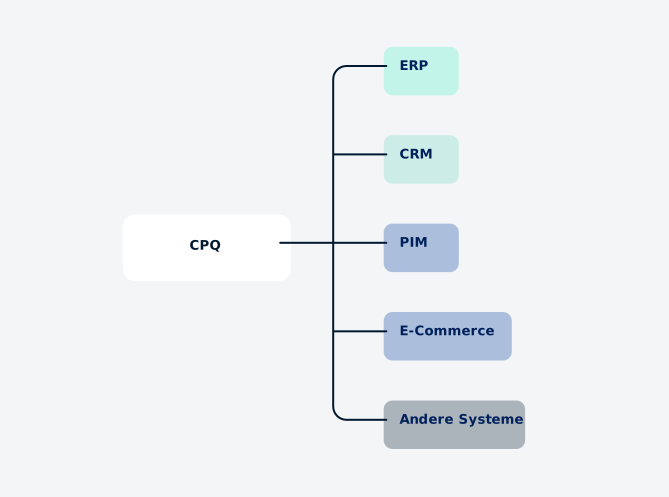
8. How does synchronization with ERP, CRM, PIM, and other systems work?
Many CPQs perform well in demos, but later fail due to poorly defined interfaces. Therefore, ask:
- Which systems are connected as standard?
- How does the update of prices, rules, or product data work?
- How are interfaces monitored, and what happens if data is not transferred or is transferred incorrectly?
Without clean integration, a CPQ quickly becomes an isolated solution—no matter how well the configurator works on its own.
9. How automated and error-free are quotations and documents generated?
The quotation process shows how smoothly CPQ really works. Pay attention to:
- Fully generated documents (no post-processing necessary, but possible)
- Automatic transfer of product and pricing logic
- Uniform text modules
- Versioning and traceability
- Roles & rights
Tip: It's not just quotes that should be generated at the touch of a button. A powerful CPQ system also automatically generates parts lists, dimensional drawings, technical documents, and assembly instructions – consistently, accurately, and always based on the latest product and pricing logic. The more of these documents the system creates itself, the less manual work, queries, and errors arise in the rest of the process.
GENERAL
In addition to functions, it is important how transparent and future-proof the system is.
11. How transparent are the licensing model, hosting, and subsequent costs?
Many costs do not arise at the start, but later on:
- additional roles
- new dealers
- more users
- extensions
- API limits
- hosting costs
Always ask for specific scenarios: “What will the system cost us in 3 years with 40% dealer growth?”
12. What about scalability, roadmap, and support?
A CPQ rarely stays the same as when it was introduced. It either evolves or it doesn't. So ask yourself:
- What features are planned?
- How often are there updates?
- How quickly does support respond, and do I have a personal contact person?
- How transparent is the roadmap?
A clear product strategy is an important quality feature - also to ensure that you can scale with the system in the long term.
Bonus: Questions for manufacturers with a dealer or distributor network
Dealer networks have additional requirements that not every CPQ can meet. This is where major differences between providers arise.
1. Can retailers get their own configurator?
Many manufacturers want to offer retailers their own interface without having to operate multiple systems. Ask specific questions:
- How flexibly can the configurator be adapted to individual branding?
- Is there a central system basis - i.e., a uniform database that can be used for multiple retailer configurators?
2. How granular can retailer rights be assigned?
Rights are used to control which retailers have access to certain products, variants, or prices.
Ensure clear role models, visibility restrictions, and channel-dependent pricing logic. The more granular, the more secure.
3. Can retailers create offers independently?
Also clarify whether dealers are allowed to create quotes independently - i.e., whether they can configure, view prices, grant discounts, and generate their own documents. A well-managed CPQ system greatly reduces the workload for the sales department and significantly reduces the number of queries.
Conclusion
These 12 questions - supplemented by bonus points - cover precisely those areas where CPQ projects stand or fall in practice.
They help you to differentiate between providers at an early stage and identify typical pitfalls before they become a problem.
👉 Want to learn more?
We take the time to understand your situation and show you how a CPQ system can be set up effectively. Get a no-obligation consultation now.
